In 2012, Alex Beachum had an idea about exploration.
A graduate student studying game design, he wanted to make a game that rewarded curiosity, not a game about defeating enemies or conquering places.
So he got to work.
He made some game demos, challenged himself creatively, and combined a bunch of disparate ideas into a concept of an astronaut exploring a mini-universe.
This is the entire premise for one of the most thought-provoking experiences I’ve ever had in any creative medium: Outer Wilds.
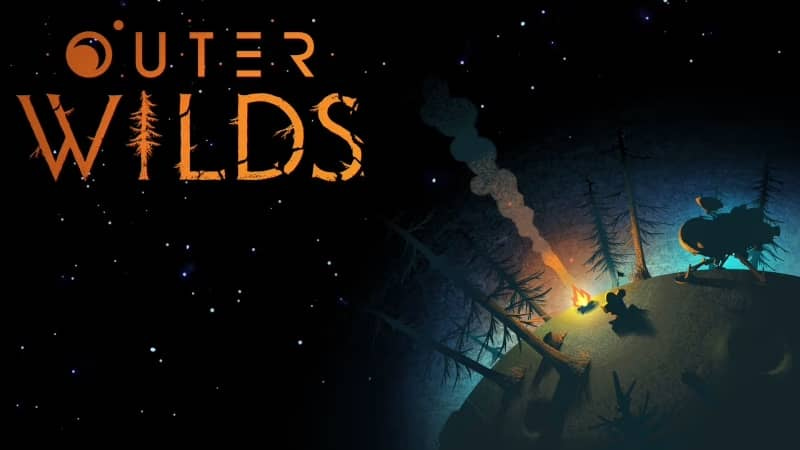
Beachum’s year-long thesis became the project he would spend the next seven years working on.
Because along the way, nerd worlds collided:
Remember the show Heroes on NBC?
Actor Masi Oka, who played the delightfully optimistic Hiro, became a developer and founded the company Mobius Digital.
During a demo day for USC Interactive Media & Games, Oka stumbled across Beachum’s solar system exploration game, and was so impressed that he hired Beachum’s entire team to bring this game to life.
Initially supported via a gaming crowdfunding site, Mobius Digital eventually secured funding from Annapurna Interactive to produce and publish the game. Beachum’s sister Kelsey Beachum helped craft the game’s narrative, Andrew Prahlow created the ephemeral soundtrack, and the came was eventually released to critical acclaim.
And in 2019, Outer Wild was released and nerds rejoiced.
This is one of the most incredible experiences of my 30+ year gaming career, and I will take any excuse to talk about it.
For example, writing an essay dedicated this experience.
I almost hesitate to say any more beyond “DON’T LOOK UP ANYTHING ELSE AND PLAY THIS GAME ,” but I have an important lesson to pass along that can change your life.
If you want the full story of the game’s development, noclip’s documentary on YouTube is excellent.
Knowledge Carries Over
Outer Wilds is a game without weapons. There is no leveling, nor experience, nor items that are acquired. There’s no resource gathering or building.
This is a game about knowledge.
*MINOR SPOILERS AHEAD*
You will explore the solar system and die repeatedly. You’ll crash into planets and accidentally fly into the sun and get your space suit punctured by a cactus and get sucked into a black hole.
And if you actually manage to survive for 22 minutes, the sun blows up for some reason! Each of the 5 planets (and few other locations) has various mysteries to solve and puzzles upon puzzles that connect.
Thanks to the big unsolved-mystery of “why am I caught in a time loop?” your character will relive the same day over and over, just like Bill Murray’s character in Groundhog Day, but also mixed with Christopher Nolan’s Interstellar.
And just like in Groundhog Day, your knowledge of each previous run carries over to the next loop.
Bill Murray used this knowledge to dominate Jeopardy, learn to play the piano, and become a master ice sculpture, etc.
In our game, we use the knowledge and our own curiosity to be an intergalactic crash-test dummy, learning what to do and what not to do, solving mysteries in seconds (that used to take 20-minutes) because we learned the pattern or secret.
Here’s how that might work in practice in the game:
Let’s say you stumble across a maze, and you spend 22 minutes trying in vain to make it to the finish line. Seven attempts later, you now know how to get through the maze, and you can do so in 60 seconds, which now allows you 21 minutes to explore what happens after the maze.
You didn’t level up.
You didn’t acquire a key.
You didn’t get faster or stronger.
You learned what worked and didn’t work.
You acquired information and used that information to progress further on future runs.
That knowledge was the difference maker.
Which means that even though you start each “run” back at the very beginning, the exact same scenario you encountered the first time you turned the game, you now know how the world works and can advance further than before.
What starts as a tentative, cautious exploration of navigating your spaceship and exploring a planet soon becomes a loop of excitement and possibility.
Eventually, hundreds of deaths later, the mystery gets solved and you can complete the entire game in those 22 minutes.
It takes 20+ hours of failing and dying, often in hilariously tragic ways. In fact, the game rewards you for dying in certain ways.
This is the fun part: each death is motivating!
When you get to a new planet and uncover a secret that makes another planet on the other side of the solar system make sense, you’re almost like “oh man I can’t wait until I die again so that I can go solve that mystery.”
Warning: finishing the game might also make you cry and think about life differently.
(It certainly did both of those things for me.)
Knowledge is Progress
Like in Outer Wilds, real life is about starting over with retained knowledge.
And knowledge gained through failure is progress.
If you have tried and failed to build a gym habit repeatedly in the past, each new attempt is not starting back over at square one. Each attempt stands on the shoulders of past attempts.
Think about your first attempt at going to the gym. You had to find the gym, then you had to sign up. Then you had to learn how the equipment works. Where the locker room is. This is exhausting. And then you eventually stop going.
But the next time you go to the gym, you know where to go and how the equipment works. You can skip the early stages and just focus on your workout.
Knowledge remains…if you use it!
Like in Outer Wilds, progress only happens when you apply the knowledge you’ve worked hard to acquire. Ignore these lessons and you’ll find yourself stuck in the maze.
Follow the same path, do the same thing, and end up with the same result.
So each “attempt” must include something different. Maybe you learned what exercises make you demotivated to go to the gym: great! Don’t do those exercises! Maybe you learned what you love, and you discover there’s a fun class at that gym you want to try, so you use 20 Seconds of Courage to sign up and try it out. Great! Do that!
The point is to remember each failure increases your knowledge, and that knowledge must be used to break through.
I hope this email leaves you with two thoughts:
- “Steve, I’m going to play Outer Wilds.”
- “Steve, I’m appreciative of all my past failures. They taught me something and paved the way for my next attempt.
Knowledge is power, my dear rebel friend.
Now, go explore the solar system.
-Steve (philosophical astronaut)