
There’s a running joke these days about socializing and canceling plans:
It usually involves somebody who is happy when a friend or an event gets canceled at the last minute, because they didn’t really want to go.
Or, as the comedian John Mulaney puts it:

I get it. It’s cold, parking is a pain in the ass, traffic sucks, the time commitment, leaving the house is expensive, etc.
Meanwhile at home, we have large TVs and delivery and a comfy couch and digital pacifiers (our smart phones) and Netflix and social media.
Staying home alone is simpler and easier than dealing with going out in public.
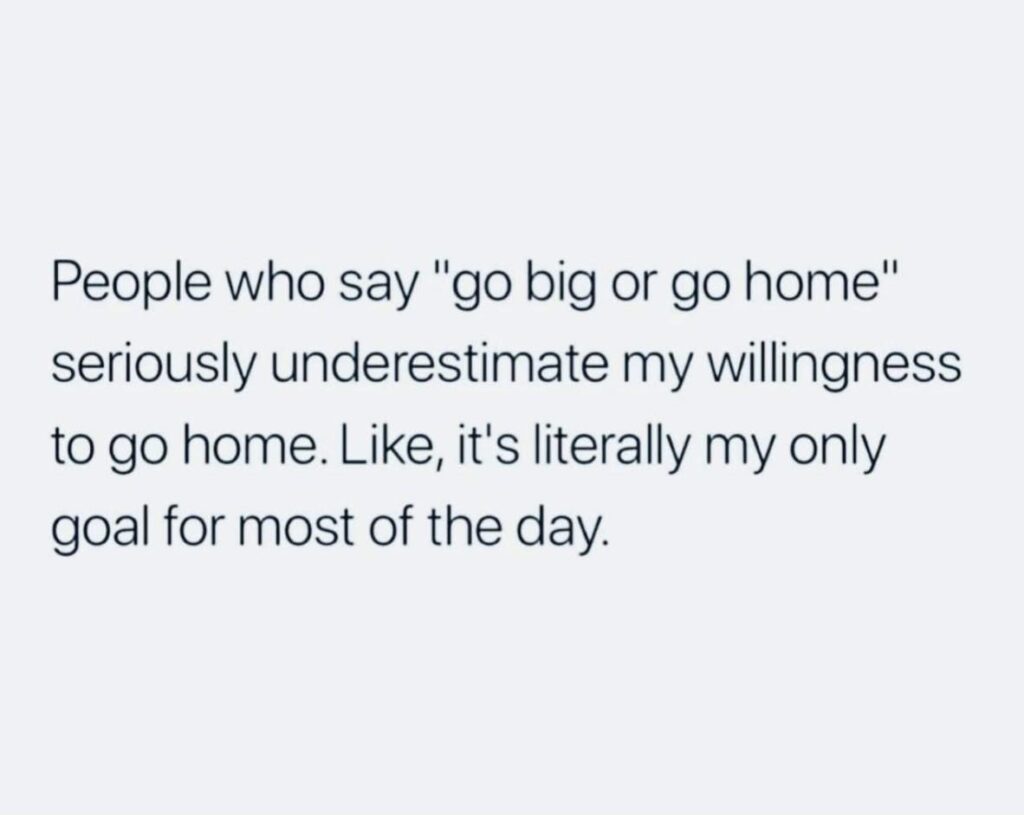
No wonder this quote from @notalogin regularly makes its way around the internet:
Factor in the rising cost of doing literally anything and staying home looks more and more appealing by the day.
As the writer Derek Thompson explains in his essay, “the Anti-Social century,” every year we get more data confirming what we all know to be true:
- We spend 20% less time socializing in person than we did 20 years ago.
- There’s a friendship recession. In 1990, 68% of men had 5+ close friends. In 2021, it’s 41%. In 1990, 60% of women had 5+ close friends. In, 2021 its 37%.
- The percentage of people who said they had “no close friends” has risen sharply too, up to 15% for men and 10% for women in 2021.
- Attending parties, hosting dinner parties, club membership, church attendance, etc. are all at historical lows.
The end result?
A “loneliness epidemic” according to the US Surgeon General.
Which brings us to a paradox:
Socializing is really important to our personal wellbeing and a healthy society.
We’ve structured our lives and society to spend more time alone than ever.
If you also wish you saw your favorite people more often but also love staying home, you’re not alone!
I’m guilty of this more often than I care to admit.
But I made one mindset shift about 18 months ago that changed my overall happiness, and it might help you too.
Social connection is the key to a good life
Earlier this year, I read The Good Life by Robert Waldinger MD and Marc Schulz PHD.
(You might remember me mentioning in this book in a previous essay, “The Lies We Tell Ourselves.“)
These authors are the current stewards of the famous “Harvard Study.”
For the last 84+ years, the Harvard Study has tracked, interviewed, and measured its participants in real time across years and decades, along with their families, and their children, and their children’s children, and so on.
It’s an amazing look into people’s lives, physical health, and mental health, and they reached a pretty strong consensus for what creates a “good life:”
“One crucial factor stands out for the consistency and power of its ties to physical health, mental health, and longevity.
Contrary to what many people might think, it’s not career achievement, or exercise, or a healthy diet. Don’t get us wrong; these things matter (a lot). But one thing continuously demonstrates its broad and enduring importance:
Good relationships.”
In addition to the Harvard Study, this book looks at other studies with different cultures and communities around the world:
Researcher Julianne Holt-Lunstad and her colleagues looked at 148 studies conducted in countries all over the world (Canada, Denmark, Germany, China, Japan, Israel, and others) with a combined total of more than 300,000 participants.
This analysis echoes the findings of the study highlighted in the article in Science: across all age groups, genders, and ethnicities, strong social connections were associated with increased odds of living longer.
In fact, Holt-Lunstad and her colleagues quantified the association: incredibly, social connection increased the likelihood of surviving in any given year by more than 50 percent.
We all instinctively know this.
Being with our favorite people makes us happy and healthier. Duh. I’m not surprised that my gramma lived to 95: she had one of the most active social lives I know up until her final year.
At the same time, we’re hanging out less with our friends than ever before.
Societal trends and technology have restructured life in such a way that we’re interacting with other humans less too.
This is worsening our mental health and physical wellbeing, along with a society that’s distracted and divided.
(Well, that and *gestures wildly everywhere* all of this too)
So where does that leave us?
Studies show we will be happier if we spend more time with friends and out in society, but we opt for the easier, more comfortable, safe choice to stay home.
Wait a second.
An activity that we know is good for us….
That helps us live longer, healthier, happier lives…
That makes us feel good if we can get ourselves to actually do it…
That modern society and our brain chemistry make it difficult to do regularly…
Boy that sounds a lot like building a fitness routine, doesn’t it?
Social fitness: the term that changed how I thought about connection
In The Good Life, Waldinger and Schulz use a term called “social fitness.”
When I read this, it made me angry. Not because I didn’t like it, but because I wish I had come up with it. It makes so much sense.
These days, we have to be very deliberate about both. For most of human society, we had to exercise, and we had to socialize. Now, we have society and technology that makes it really easy for us to not exercise and not socialize.
If we’re interested in bettering ourselves physically and mentally, we need to treat both parts of our life with the same mentality:
“We have to set time aside to walk, garden, do yoga, run, or go to the gym. We have to overcome the currents of modern life.
The same is true for social fitness.
It’s not easy to take care of our relationships today, and in fact, we tend to think that once we establish friendships and intimate relationships, they will take care of themselves. But like muscles, neglected relationships atrophy.
Our social life is a living system. And it needs exercise.”
Think about it this way:
We have no problem understanding that exercise can be hard, and makes us uncomfortable (sweaty), but it’s good for us. We are proud of ourselves for overcoming resistance.
We should be treating socializing the same way. Yes it can be hard, or make us uncomfortable (and maybe sweaty), but it’s good for us. We can be proud of ourselves for getting off the couch and going out into the world.
This was the biggest change I’ve made in my life in the past two years.
Steve remembers that he likes people
I am fortunate to have amazing friends and family and write for a living.
At the same time, I enjoy work and know how important exercise is. For the longest time, fitness and work came first, friends and socializing came after. Throw in my recovering “insecure overachiever” syndrome and it was a recipe for “I wish I saw my friends more, oh well. Back to work!”
(I’ll blame the 16th century Protestant reformation for Western Society’s obsession with the “hard work equals salvation” mindset, because it’s not here to defend itself.)
I also love video games, I’m a bookworm, I love movies, my couch is comfy, I spend too much time on my phone, and I get frustrated with being out in public.
If I’m not careful, it’s really easy for me to spend time home alone overriding my brain’s “loneliness” setting with technology, and not seeing my favorite people for long periods of time.
Like many people during and after the pandemic, I had become pretty introverted.
I’m sorry to say that I had many friends who I only saw every few months, despite always saying “that was amazing, we should hang out more often!”
But then things changed.
And as I was rebuilding my life in 2024, I finally asked myself “what makes Steve happy?” and I realized that I really like people. People make me happy.
I started thinking about my social fitness just like physical fitness was a lightbulb moment:
- There are times I don’t want to work out. And then I work out. And 99% of the time, I say “I am SO GLAD I DID THAT!”
- There are times I don’t want to leave my house. And then I go. And 99+% of the time, I say “I am SO GLAD I DID THAT!”
Most importantly, I decided to restructure my life largely around seeing my favorite people more often:
I rented a house two blocks from my best friends. I now see them at least once a week instead of every few months.
I attended nearly every Vanderbilt football game together with my college friends:

I also invested in “loose ties” in my local community.
I mostly work out of coffee shops or coworking spaces where I see familiar faces. I know the people in my neighborhood. I know the people who work in the coffee shops, restaurants, and spaces that make up my part of town.
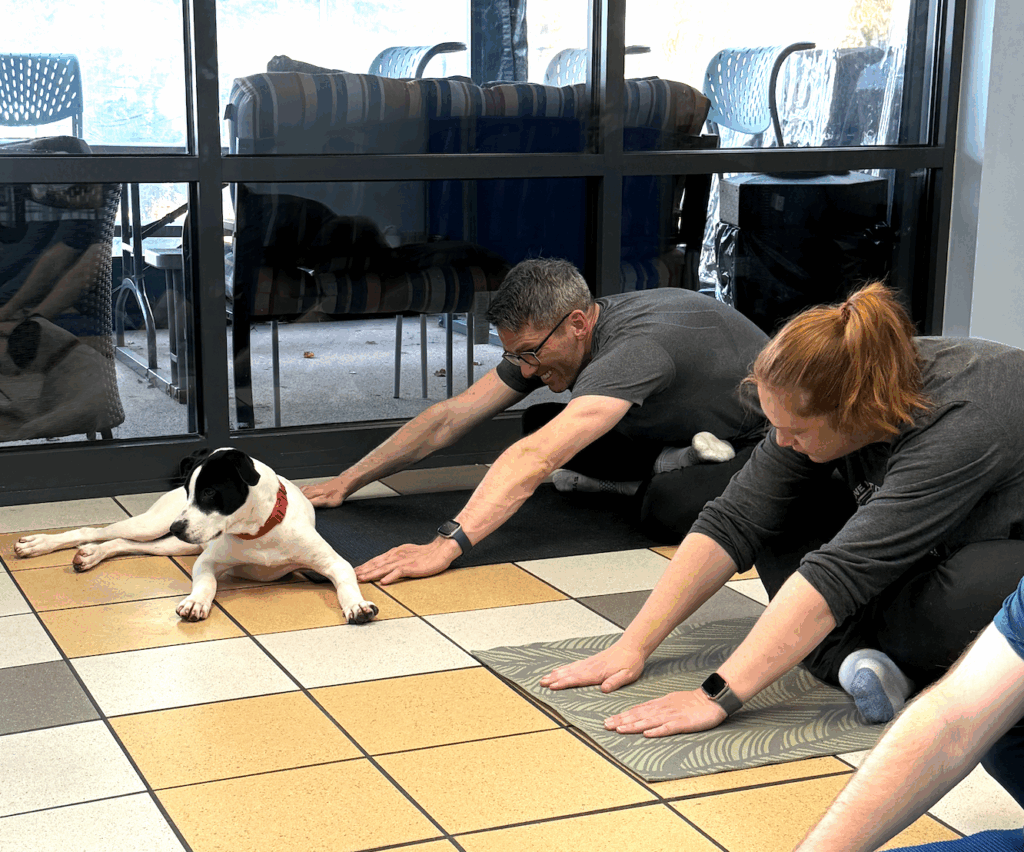
I even went to rescue puppy yoga to support an amazing organization helping find homes for rescued dogs:
Yep, I’ve spent more money on this stuff than before, but not dramatically so. I’ve simply decided this was that important and cut back my spending elsewhere.
It has been worth every penny.
I feel more connected to my fellow humans, friends, family, and my town than ever before. If researchers approached me today and said “How is the quality of your life right now?”
I think I would rate my daily happiness “pretty damn high.”
How’s your social fitness?
People largely determine our happiness on a day-to-day basis, because that’s how we live life:
One day at a time.
Life is unknowable and messy, and people will be there through all of it. As Waldinger and Schulz explain:
“The good life is joyful… and challenging.
Full of love, but also pain. And it never strictly happens; instead, the good life unfolds, through time. It is a process. It includes turmoil, calm, lightness, burdens, struggles, achievements, setbacks, leaps forward, and terrible falls.”
People are the only way any of us get through these coming decades.
Society and technology will continue to make it easier and easier for us to avoid physical connection. Which means our social fitness will only become more and more important if we’re gonna navigate an unknowable future together.
We need to do the hard work of prioritizing socialization, even when we don’t want to. Like working out, we need to put this at the top of our priorities because it’s that important.
Note: if you’re thinking, “Gee Steve, thanks for giving one more thing to feel bad about! I struggle to make time to exercise, and feel bad about that. Now I can feel bad about not making time for my friends too!”
I have good news: you don’t have to feel bad about exercise. You also don’t have to feel bad about this either.
This stuff is hard. Society is working against us. Technology isn’t designed for our mental health.
Here’s an idea that might work for you: Combine socializing and fitness!
Invite a friend to an exercise class or hike with you. Join a club of people who already exercise the way you want to exercise. Volunteer with a friend.
We don’t have to spend lots of money either. Going for a walk with a friend or inviting a friend over for a home-cooked meal can be as inexpensive as it is life-giving!
I hope this essay can convince you ONCE to not cancel plans and to follow through on a social obligation.
Maybe it will convince you to say yes to something you would have said “no thanks, the couch is comfy and this is easier” and get out into the world.
Your wellbeing needs it.
Here are some questions worth pondering:
- How would you describe your “social fitness” right now?
- If you’re honest with yourself, is loneliness something you struggle with?
- How can you make space for the relationships that are really important to you?
-Steve