
Let’s talk about a complicated topic: failure.
After spending years researching failure for How to Try Again, my relationship with it has changed, all thanks to a trip to the actual Museum of Failure.
Okay, I actually failed to get to the Museum of Failure the first time (my friend bailed on me!). But then we got there the next day.
This is a story about how the last exhibit in the museum changed my relationship to failure. Maybe it’ll do the same for you.
This is an excerpt from How to Try Again.
Failure connects us all, so let’s talk about it.
If you’ve failed or sabotaged yourself at some point in your life, you’re in good company.
We’ve done this song and dance for so long the ancient Greeks even had a term for it. “Akrasia” means “acting against one’s better judgment.”
The ancient Greeks also had a term, “callipygous,” which means “having beautiful buttocks,” which I thought bared mentioning. (Cough.)
If the ancient Greeks had a word for it, we can take solace in the fact that we’re not doing anything out of the ordinary or uncommon to the human experience when we mess up.
This is where the Museum of Failure really shines.
After a few hours of exploring, I walked toward the exit and stumbled upon the most important exhibit of all: a wall of multicolored Post-it notes from guests who had written out their deepest, most personal failures.
It was a kaleidoscope of a thousand notes, each a declaration from somebody who screwed up.
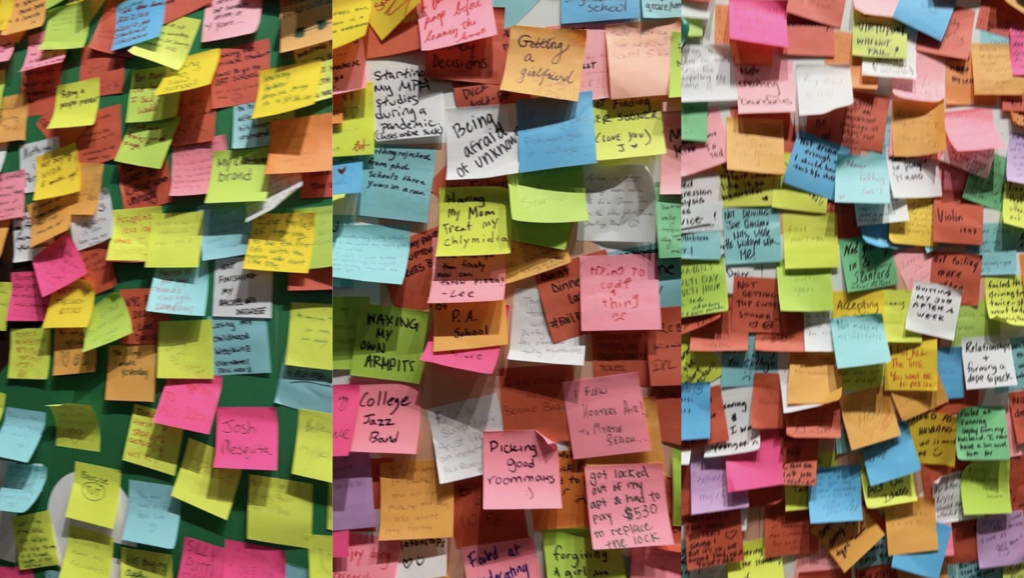
One read “Three failed start-ups,” while another lamented “Two failed marriages.” “I failed nursing school” was sandwiched between “Not finishing my bachelor’s degree” and “Tried to cut my own bangs.”
“I farted in yoga” was the most honest sticky note on that board, though that’s less relevant to the point I’m trying to make here. I just thought it was worth pointing out, in case you’re the person who left that note. I salute you, yoga-farter.
This Wall of Failure exposed the depths of the collective human struggle in a way that was surprisingly uplifting.
Not because I wanted to wallow in others’ misery, or because it made me say, “Could be worse.” Hearing about other people’s failures helped me realize I wasn’t alone.
(And boy, have I needed this reminder lately.)
When we suffer in silence with failure, it has a way of growing and growing in our minds. It lies to us about how bad we are, and how much additional torture we must put ourselves through. None of this is true. But that’s not apparent until we share our failures with others, when we realize we’re all going through something.
Many failures are outside of our control. Others are because we made a very human mistake or didn’t show up as our best self. It happens. Connecting with others who have also failed is an amazing way to remember we’re all in this together.
I’ve thought a lot about the Wall of Failure lately.
It has helped quiet the voice in my head that told me my failures were identity-defining. That nobody had ever gone through what I was going through. That I deserved the guilt and shame I found myself wallowing in, simply because parts of my life didn’t go according to plan.
It turns out I’m not that unique!
Not only were my failures common, but there were thousands of people who had gone through similar challenges. After waiting for eighteen months to heal (and also partly out of shame, sadness, etc.), I shared an update about the end of my marriage and my business struggles in THIS newsletter.
The response was overwhelming and overflowing with support. Many readers thanked me for giving them the courage to share their own.
Like the museum’s Post-it notes, each reply made me feel more connected with my fellow human disasters who had failed in similar ways and offered advice if they were further along in their journey. I was moved to tears.
This changed my perspective and gave me the courage to share this story in my book. Failures shouldn’t be kept private or hidden in shame. When we talk about them, it can take away the power they have over us.
We are human, therefore we will fail. A lot. We might as well talk about it.
Sharing our failures with others isn’t just a cathartic release of shame. It’s a badge of honor that shows “I was brave enough to try something.” Perhaps most important, sharing our failure might help somebody else who is currently destroying themselves silently for their own failure.
No matter how badly you’ve failed, or whatever flaw you’re currently beating yourself up for, I want you to know you’re not alone. You’re part of a nonexclusive club: forgivable humans who try things and fail often.
There are hundreds of thousands of years of history with billions of people who have failed at similar things as you and me.
Whether it’s a failed workout or a failed diet, a failed business or a failed relationship, it’s definitive proof that we are human, part of an unbroken lineage of fellow weirdos, held together with spit and duct tape.
Although our failures might feel like they’re uniquely our own, talking about them with our friends will reveal a universal truth: We’re all struggling, we’ve all failed, and we’re all in this together.
So, wherever you’re at in your current struggle, you are right where you need to be.
Not because you’re beyond repair. But because you’re human.
Welcome to the club!
There are eight-billion-plus of us.
Want to get the first chapter of my book, How to Try Again? Subscribe to my newsletter and I’ll send it over:
Let’s fail together
I’m not here to gloss things over.
Failure can still totally suck sometimes. It can also be a catalyst for changes we’re proud of.But we don’t need to figure all of that out right now. We can just let failure be a thing that happened, and decide where to go from here.
Today doesn’t need to be a day to make a dramatic declaration, or draw up a new life plan. It doesn’t have to be a day for judgment or surrendering or tormenting ourselves, nor a day to say “Look on the bright side.”
It can be a day where we forgive ourselves for being human.
If you want to feel less alone, visit HowToTryAgain.com/Fail where you can see the failures of other anonymous readers who were brave enough to share.
If you’re up for it, add your own anonymous failure!
(By sharing your anonymous failure, you consent to it possibly being used when I talk about the book or in newsletters. Thanks!)
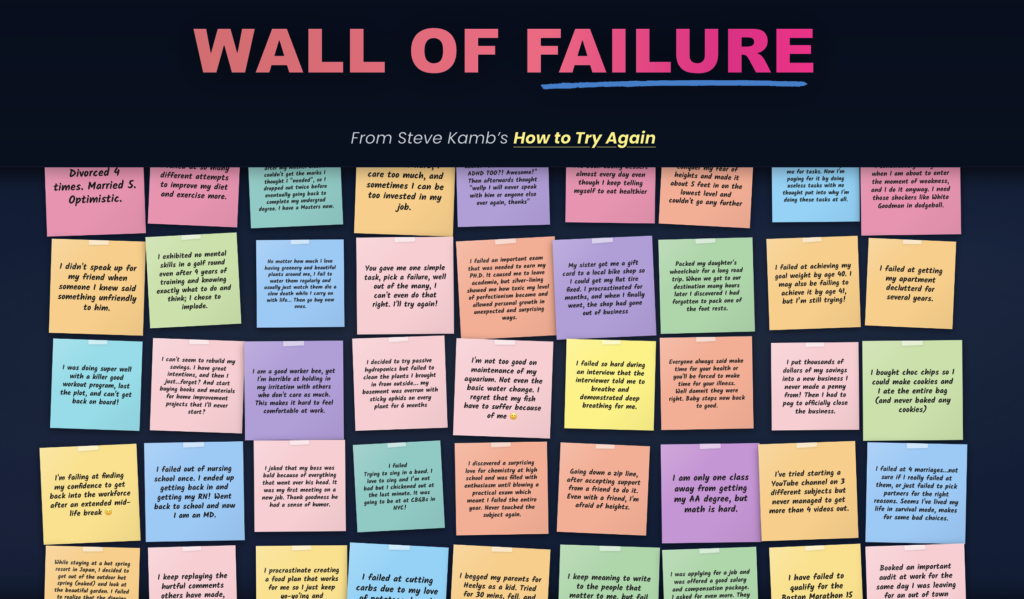
Sharing our failures can help take away some of their power, and might help somebody else navigate their own struggles.
More importantly, connecting to a larger group of humans who have also failed can remind us that we’re all in this together and that our failures got us here.
We’ve survived one hundred percent of our failures so far.
And as Jean Craighead George wrote in My Side of the Mountain:
“The sun has a wonderfully glorious habit of rising every morning.”
I’m here writing this. You’re here reading this. Which means we both woke up today.
That’s a good start!
We can build on that.
-Steve
PS: This essay is adapted from Chapter 1 of How to Try Again, which is now out in all formats in countries around the world.
There are free book bonuses when you send in your receipt! Simply forward your receipt to 1book@stevekamb.com!