The beginning of a new year is full of hope and optimism.
Lots of people have bought fancy new journals, received a new exercise bike for Christmas, and have a goal to finally write their first novel. Lovely!
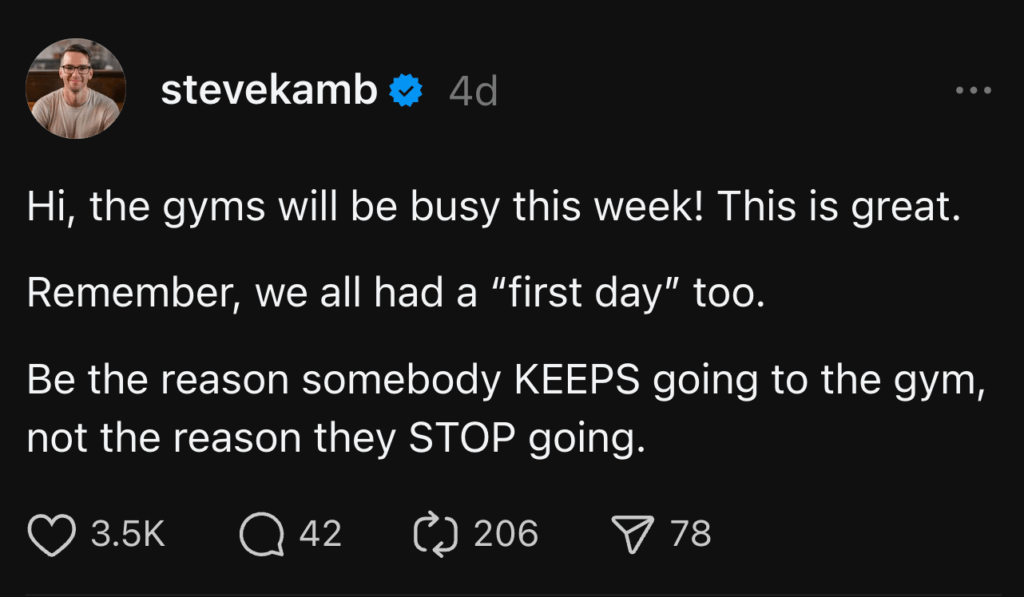
And gyms will be busy this month. I love that!
Wanting to better ourselves, have more money in the bank, or work on a big project is fantastic. And picking a goal is often the first step to getting us off our couches and out doing something.
I have hopes and expectations for 2026 too, but I’m trying to approach things with a different mindset. Unsurprisingly, I’m already struggling! In my defense, I’ve struggled with this for most of my life; I just didn’t realize it.
I’m talking about expectations.
I don’t want us to be doomed before we even begin our next attempt to change, so let’s reframe our relationship with the expectations we place on our New Year’s resolutions, goals, and experiments. Cool? Cool.
Here are a few cautionary tales that helped me think differently: a heartbreaking story from reddit, and the story of how LASIK ruined a woman’s life.
I can’t let myself be “enough” until…
On Reddit, somebody once asked “What’s the worst part about being [overweight]?” One of the most upvoted answers was as honest as it was heartbreaking:
“The fact that you put your whole life on hold, telling yourself that you will resume living when you lose the weight.
Then not being consistent with said weight loss journey and basically…never getting to truly live.”
We tell ourselves we need to avoid photos until we reach a certain weight. We decide we can slow down and enjoy life and spend more time with our kids after we reach a certain level of success. We’ll finally feel worthy once we reach X followers or Y job title or Z amount of admiration from our peers.
We put life on hold “until…”
The reality is that we will probably come up short on most of our goals. Not because we’re failures. Not because we’re broken.
We’ll run into issues because we’re human and because life will happen!
Maybe our kid gets sick or we get dumped or lose our job. Maybe we only lose some of the weight, or fill up part of our journal, or follow the yoga routine for only a few weeks. Maybe we’ll discover “running a marathon” isn’t actually a goal we care about.
These aren’t identity-defining events.
They’re things that happen.
A missed goal is only a problem if our entire self-worth and value requires us to have been successful at completing it. If we tell ourselves we’re failures “until I reach this goal,” we wake up every day feeling behind and not enough.
And then when we don’t reach our goal, we beat ourselves up for failing and then move onto the next goal which we’re already behind on too.
Let’s stop doing this to ourselves. We are missing out on the life we could be living right now, with the people that are important to us, no matter where we’re at on a goal or dream or experiment. Tomorrow is no guarantee, and we cannot live exclusively for a time “after,” because we might never get there.
So, what happens when we reach our goals?
That’s when the real problems can start. So fun.
How LASIK ruined a woman’s life
In author Morgan Housel’s The Art of Spending Money (which is really about society and expectations and comparisons), Housel shares a tale about a woman’s complaint to her doctor after LASIK surgery:
She returned for a checkup a few weeks later, despondent.
She said the surgery ruined her life. There was nothing wrong with the procedure — she could see clearly without glasses for the first time in years.
[Dr.] Goodman pressed: Then what’s the problem?
The patient said she expected that after losing her glasses, her husband would find her more attractive and her coworkers would find her more intelligent.
When she realized they didn’t, and love and respect weren’t driven by something superficial like her glasses, she was crushed. “You have a problem I can’t help you with,” Goodman told her. “I’m sorry I didn’t realize it earlier.”
It’s astounding to witness someone gain what they thought they always wanted only to realize that happiness is more complicated than they first assumed. And, my gosh, that is so true with money.
There’s an old saying that nothing’s worse than getting what you want but not what you need.
When we feel “less than,” we dream about a magical future when we complete a goal, reach a certain level of success or number on the scale, and then all of our problems will be solved.
People will treat us differently and everything will be better and then we can be enough.
Time and time again, reality paints a very different picture.
Why? Because wherever we go, there we are. We are still the same human, with the same insecurities and mental baggage and anxieties and history…just now with a flatter stomach or more money.
If we weren’t enough without “it”, we won’t be enough with “it” either.
Some of the richest people on the planet are the most miserable.
Hollywood is full of cautionary tales because all the fame and fortune couldn’t fill the void in somebody’s life.
I know many folks who got in incredible shape assuming it would make other people love them, or it would finally allow them to love themselves. Unfortunately, it just made them more neurotic and self-critical, because now any flaw was unacceptable.
As I said at the top, wanting to get in shape, or create something, or be more financially stable are all worthy goals. (Especially as five companies try to replace all of us with robots and algorithms and make life more uncertain than ever).
Having a goal or experiment we’re working on is worthy and worthwhile. “I want to get strong and build confidence” got me into the gym as a 16-year old, and eventually led me to starting Nerd Fitness and eventually to writing this newsletter!
The problem is when we assume “achieving this goal” will solve all of our problems, fill the existential void we feel, and finally make us happy.
In Madeline Miller’s The Song of Achilles, Achilles and his ward Patroclus are discussing what their future may hold before heading off to war:
[Achilles’s] eyes opened. “Name one hero who was happy.”
[Patroclus] considered. Heracles went mad and killed his family; Theseus lost his bride and father; Jason’s children and new wife were murdered by his old; Bellerophon killed the Chimera but was crippled by the fall from Pegasus’ back.
“You can’t.” He was sitting up now, leaning forward.
“I can’t.”
“I know. They never let you be famous and happy.” He lifted an eyebrow. “I’ll tell you a
secret.
“Tell me.” I loved it when he was like this.
“I’m going to be the first.”
(2,700-year-old spoiler alert: things do not work out well for Achilles or Patroclus.)
Now, I know. We can read story after story of people who reach a certain level of success or thinness or financial success and are still miserable.
But then our brains will still try to tell us “But it’s different this time for our situation!”
It’s like in Arrested Development where Linday and her husband Tobias are talking about “opening up” their relationship to save it, even though it hasn’t worked for anybody else:
Okay I really just included this section because I wanted to include this meme, and because Arrested Development is still criminally underrated.
Now, of course there are plenty of successful, happy people who have achieved a goal, fame and fortune, and are still happy.
So, how did they do it?
What was different for them?
You’re already enough, whether or not you “get there”
Okay, you might be thinking, “Steve, thanks for all the cautionary tales, what do I do with this? Not have any goals, move into a cave in the woods and start knitting my own underpants?”
Maybe!
But, probably not.
We can still pick goals and experiments, and then also understand that 99.99% of our lives will be spent NOT “having just achieved an important goal.”
It’s spent living our weird lives, trying to do the things that are important and meaningful to us, with the people that matter in our lives. That’s where we need to find “enough” and “okay” and “safe” and “worthy.”
It’s finding a way to feel fulfilled and “enough” whether or not we reach the goal.
As somebody who woke up each morning feeling behind for decades, needing to succeed to prove to myself I was enough, I’ve finally accepted that maybe a different mindset can result in less self-criticism and more fulfillment.
It can be helpful to ask “Why did I pick this goal?” And “What do I think will happen after the goal?”
It’s important to ask “If I never reached this goal, would I still pick this activity?”
(This is why I’m conducting a YouTube experiment with the only expectation being “I can find a way to have FUN doing this.”)
Asking these questions can help us pick different goals or change
It can give us the best chance to make progress without the extra pressure of “this will solve everything!”
our mindset and have more realistic expectations.
After all, not only is the juice NOT worth the squeeze sometimes, but sometimes, we don’t even want juice.
Yep, all the basic wisdom, unfortunately, is true.
- It’s the journey, not the destination.
- It’s the friends we make along the way.
- It’s not what we accomplish, but who we become.
- It’s finding exercise we enjoy and/or makes us feel good.
- It’s changing our internal dialogue while we’re trying, failing, succeeding.
- It’s understanding that no matter where we are, today is the only day we have.
Hopefully this can help you redirect your energy (and expectations) for what you’re working on in 2026!
I’m excited for you and I think you’re great, whether or not you accomplish these goals this year.
Also you look nice today.
-Steve