
Six weeks ago, an ice storm gripped Nashville.
Freezing rain turned our trees into popsicles. Roads glazed over with ice. And for a week, time stood still. Everything froze.
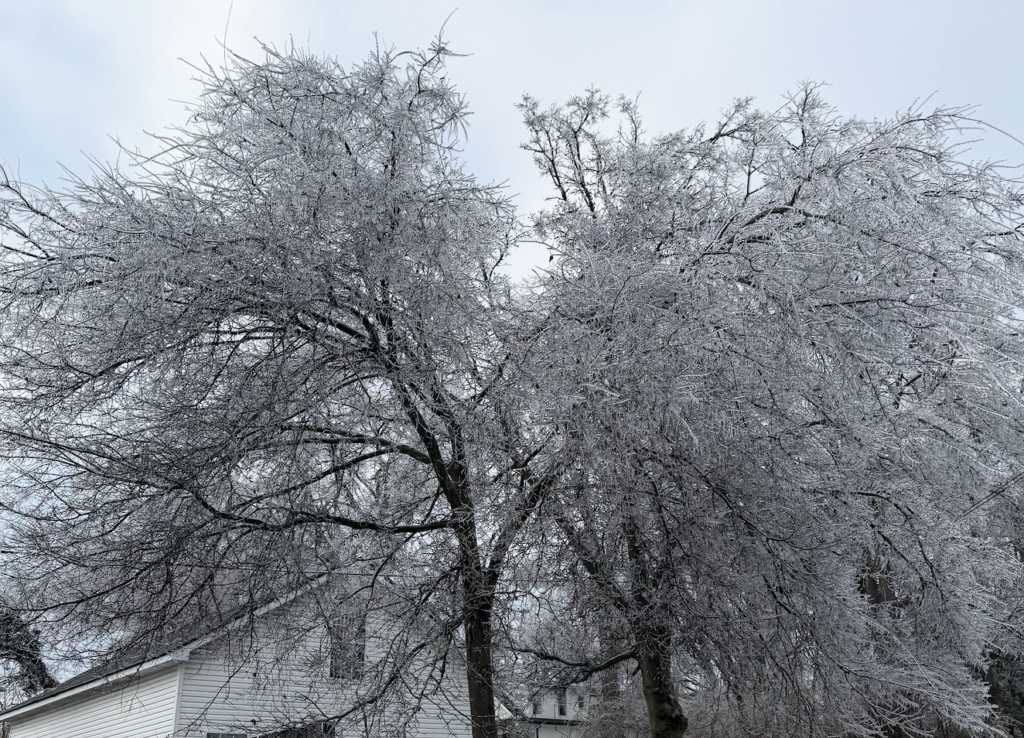
Well, not everything.
Trees were so weighed down with ice that many of them snapped and broke apart.
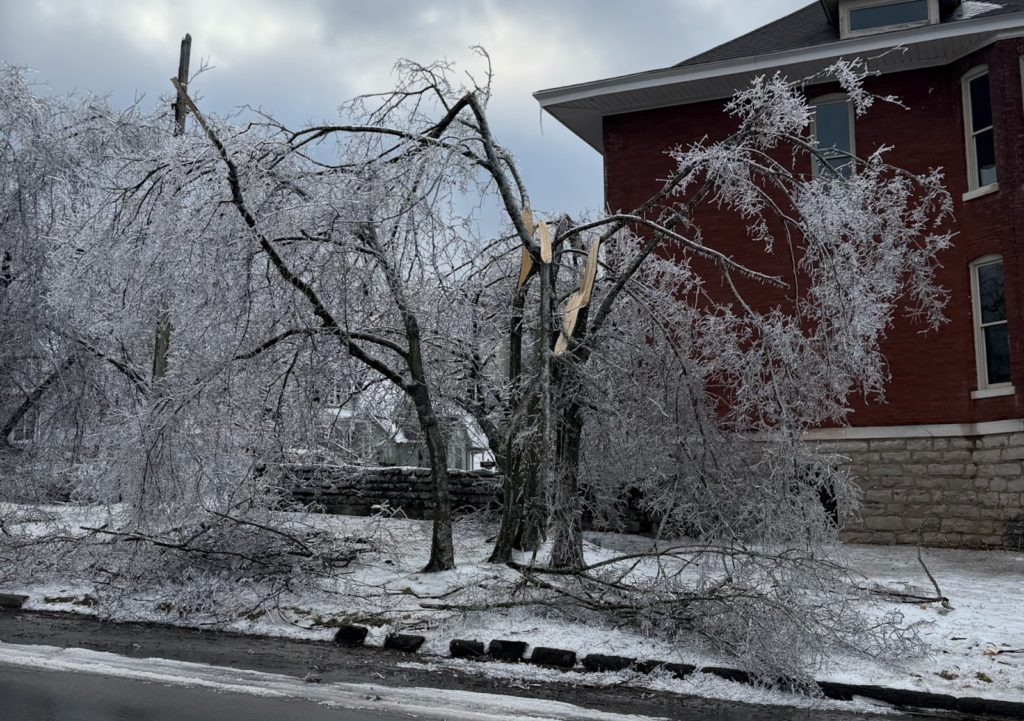
I sat inside my house for days on end, only hearing one of three things:
- Eerie silence (no cars were on the road).
- Tree branches cracking under the weight of ice.
- Large booms as trees snapped and collapsed.
Broken trees knocked down powerlines all over town, which caused power outages for hundreds of thousands. It looked like a frozen tornado had laid waste to the city.
One day, I went out for a walk (more of a “slip,” really) and I felt like a character in a post-apocalyptic show like The Last of Us.
This poor tree looked like how all of Nashville felt:
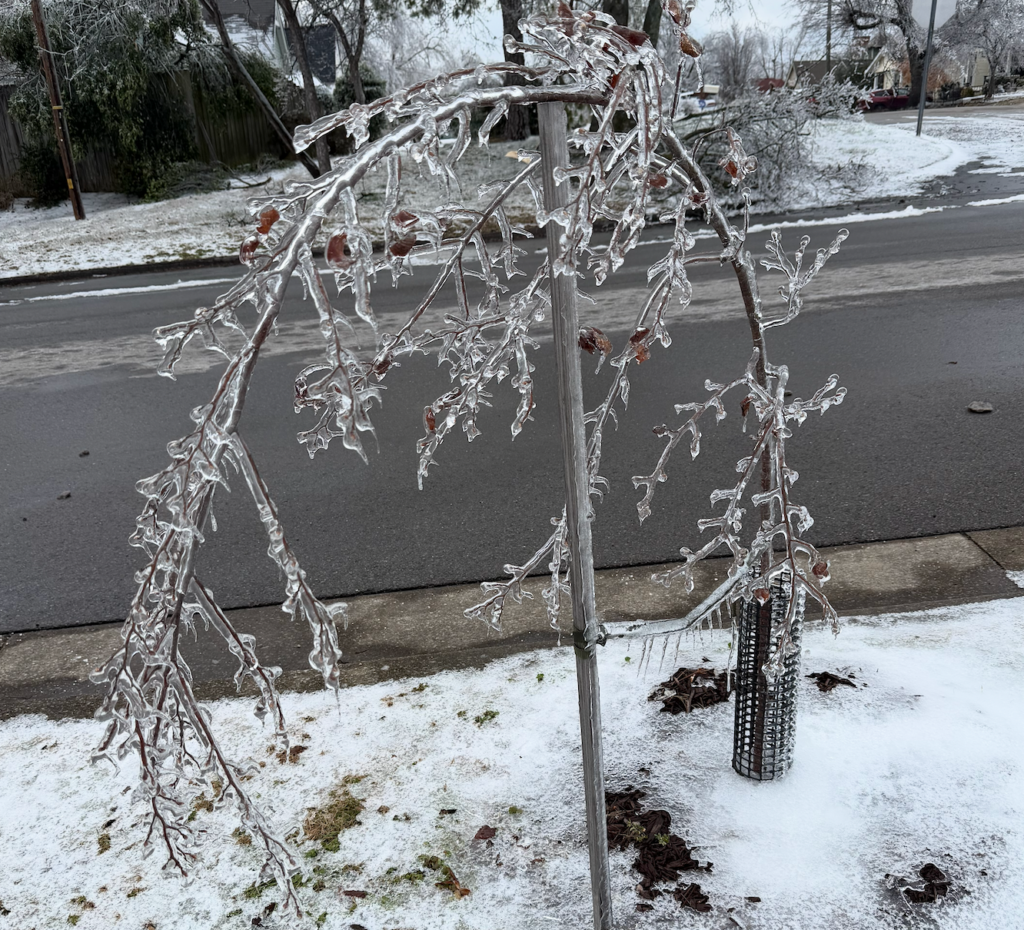
With the first of Spring right around the corner, I took a walk through that same part of town yesterday.
On those same struggling little trees, I saw new buds.
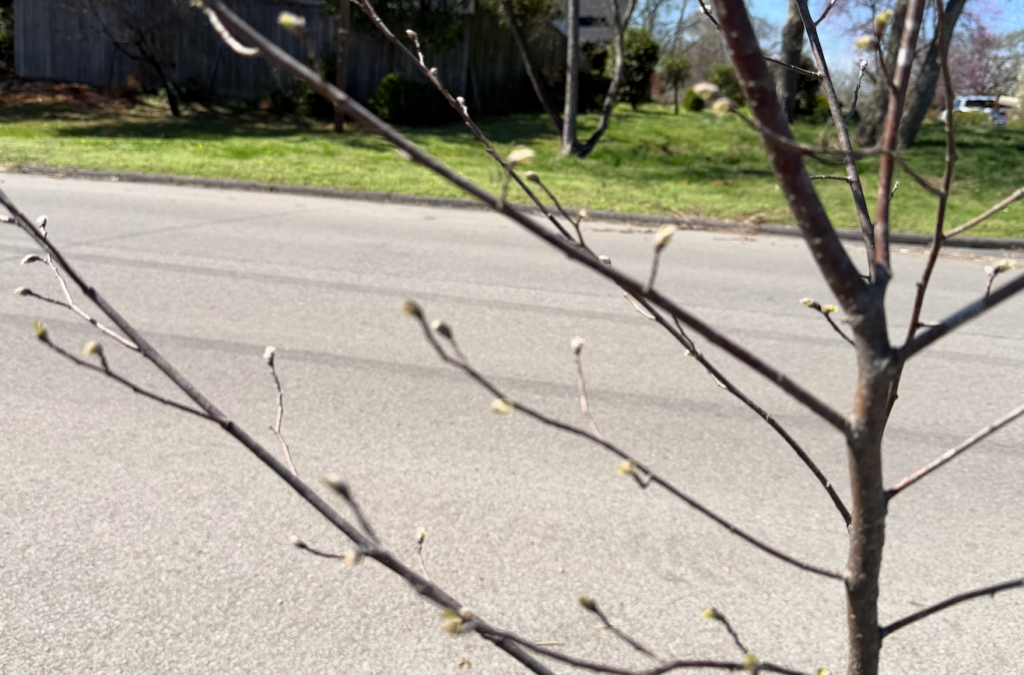
Those same trees that snapped in half had started to sprout leaves. The piles of broken branches had been cleared.
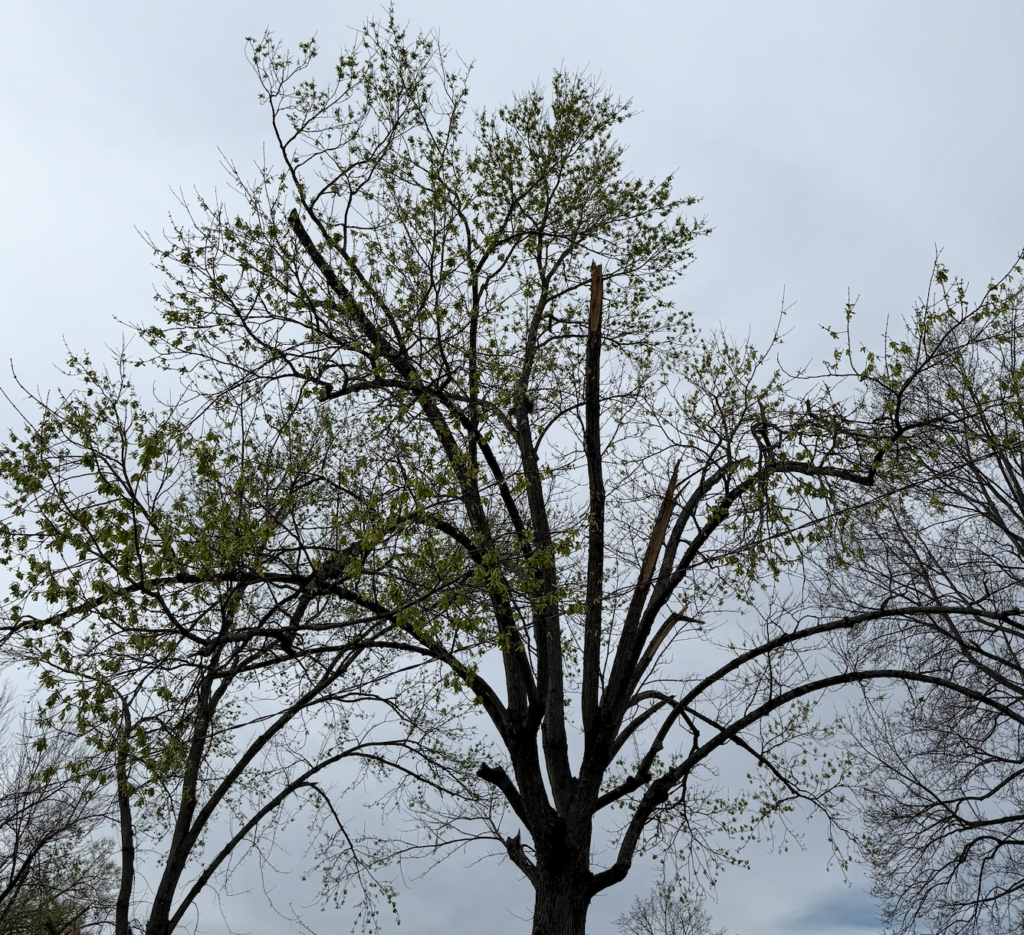
While on my walk, I couldn’t help but reflect on the quiet resilience of these trees.
It also reminded me that life happens in seasons, and growth can happen in unexpected ways.
Nature and literature kick ass
While staring up at the trees, a specific story from a children’s book popped into memory.
In Jean Craighead George’s My Side of the Mountain, a young boy named Sam runs away to live in the woods for a year, hollowing out a tree to build his new home.
During a brutal stretch of winter, Sam has to survive an ice storm like the one that just ravaged Nashville:
“Out in the open I watched one tree after another splinter and break under the ice, and the glass sparks that shot into the air and the thunder that the ice made as it shattered were something to remember.”
Sam crawls back into his tree-house, under his deerskin blanket, and waits out the chaos. The following morning, he emerges, and has a startling realization:
“The mountain was a mess. Broken trees, fallen limbs were everywhere.
I felt badly about the ruins until I thought that this had been happening to the mountain for thousands of years and the trees were still there, as were the animals and birds.”
We humans think we’ve been around for a long time, but Mother Nature and Father Time are immortal.
Some trees will lose their biggest branches. Some trees are so heavy they fall over and their roots are pulled out of the ground. Some trees won’t survive.
But other trees will snap in half, lose half of themselves, and then continue on with their lone objective: be a tree. They’ll start sprouting new branches and leaves and go on living.
They’re like the “Oh, no! Anyway…” meme:

As long as they have deep enough roots, they have a chance to survive and begin growing again in the spring.
And as our favorite linguistic nerd J. R. R. Tolkien put in his most famous poem:
All that is gold does not glitter,
Not all those who wander are lost;
The old that is strong does not wither,
Deep roots are not reached by the frost.
(Of course I quoted Tolkien. I’m talking about trees!).
We might not be tree-like beings like Tolkien’s Ents, but maybe we humans can learn a bit more from trees than initially thought.
We are trees with deep roots.
The interesting thing about a tree is that no matter what it looks like, or what has happened to it, it’s always just “a tree.”
It’s not trying to be anything else, or in a hurry to become something else. It just…is. If branches fall off, it redirects resources and grows in a different direction. It’s always a tree, and yet always growing and changing.
We humans are similar, if we could just quiet our brains long enough to realize it.
The spiritual Teacher Ram Dass once said:
“When you go out into the woods and you look at trees, you see all these different trees. And some of them are bent, and some of them are straight, and some of them are evergreens, and some of them are whatever.
And you look at the tree and you allow it.
You see why it is the way it is. You sort of understand that it didn’t get enough light, and so it turned that way. And you don’t get all emotional about it. You just allow it. You appreciate the tree.
The minute you get near humans, you lose all that. And you are constantly saying, “You’re too this, or I’m too this.” That judging mind comes in. And so I practice turning people into trees. Which means appreciating them just the way they are.”
A tree is still a tree without leaves. It can be beautiful with broken branches. It can grow in strange ways. It’s never anything other than a tree.
That’s us weird humans!
Some of us are tall. Some are short. Some of us are a bit crooked. Some of us have broken branches. Some of us bend one way or another.
But we all have deep roots.
Every experience we have, every year we’ve spent on this earth, every interaction we’ve had with others, our roots grow deeper.
We’ve survived however many winters we’ve lived up until now. Maybe we had to deliberately trim our branches back. Maybe we lost a lot of leaves over the past winter. Maybe a storm snapped us in half.
We are still us, with deep roots, and an opportunity to grow. An opportunity to find a new place to put our love.
For the last few years, I’ve felt like a frozen tree in an ice-storm.
Some branches fell off. Parts of me were split down the middle. Fortunately, I had deep roots: a life of experience to fall back on, friends to confide in, family to lean on, therapy, journaling, and a love of life and growing.
And throughout, a desire to find “Steve” under all of it.
I had a winter of hiding and breaking, now I’m growing again. Not in the ways I used to grow. But more interesting ways, for sure.
This newsletter is one.
The other is my project I spent three years writing in secrecy: a book about navigating metaphorical storms.
I don’t know what season of life you’re in, my dear reader.
If you find yourself in a metaphorical ice storm and your branches fell off, I’m sorry to hear this! I hope you can remember that you too have deep roots.
Sure, you might have lost a few branches. Maybe you got split in half. Yep. It sucks. I can’t tell you things will get better. They might! But we can’t know that.
Here’s what we do know: we’re both still here, with deep roots not reached by the frost.
That’s a good place to start. In my essay on creating hope, we can remind ourselves of all the parts that make us who we are. No individual branch tells our full story. A tree refers to all its branches and roots.
That’s us too: When you’re ready, take which parts of you are still there and find a way to make something beautiful out of something broken.
Who knows what unexpected growth might come from it.
How to Try Again Corner – Read the First 2 chapters Today!
My book, How to Try Again, comes out three months from today, on June 16th.
(I’m gonna have a little corner here at the end of each email with a fun update each week)
And so many people have already pre-ordered the book! If that’s you, thank you!!!
If not, please consider pre-ordering a copy, it helps show St. Martin’s Press (my publisher) that people are excited! Oh! I got the go-ahead from them to email a sneak preview of the first two chapters to superheroes who pre-order the book now.
If you want to support me and my writing, all you have to do is pre-order the book in whatever format works for you, then forward your receipt to 1book@stevekamb.com. I’ll send you those early pages to read!
Speaking of early reading…neuroscientist Anne-Laure Le Cunff, author of Tiny Experiments, just got a chance to read an early copy and here’s what she said:
“In a culture obsessed with optimization, failure often feels like the end of the story. In How to Try Again, Steve Kamb reframes failure as an invitation to pause and experiment. This is a compassionate and deeply practical guide to navigating failure with curiosity.”
I have a lot more fun updates and behind the scenes stuff headed your way, so there will be a little section at the end of each newsletter moving forward to share the fun stuff leading up to the launch.
Thanks for being you, broken branches and all.
-Steve (fellow crooked tree)