“Why did you just say “I’m sorry?”
Last week, I had an interesting exchange with my therapist. He asked me to explain what I look for in deep relationships.
So I proceeded to do exactly that. I shared stories, provided examples, and weaved a narrative that explained why specific values or attributes are important to me.
And then at the very end, I quickly uttered, “I realized that was A LOT! Sorry about that!”
So when he asked, “Why did you say “I’m sorry?” it stopped me dead in my tracks.
Two hours earlier, I met a friend for lunch and he asked me about my last few exciting weeks. And I did the same thing:
I ended with “I know that was a LOT! Sorry about all of that!”
So, when my therapist said, “Why do you feel the need to apologize for being yourself while eloquently and excitedly answering my question?” I didn’t have a good answer for him.
I realized I had an internal belief that I was probably offering/saying “too much,” probably as a result of years or decades of feeling like being myself would overwhelm others.
Then it all came together.
Because a few hours before all of this, that morning (I’m not kidding), I had just finished rereading my friend Nir Eyal’s new book Beyond Belief: The Science-Backed Way to Stop Limiting Yourself and Achieve Breakthrough Results.
My brain is pretty good at identifying patterns and connecting the dots, but this felt like the universe hitting me over the head with a cartoon hammer.
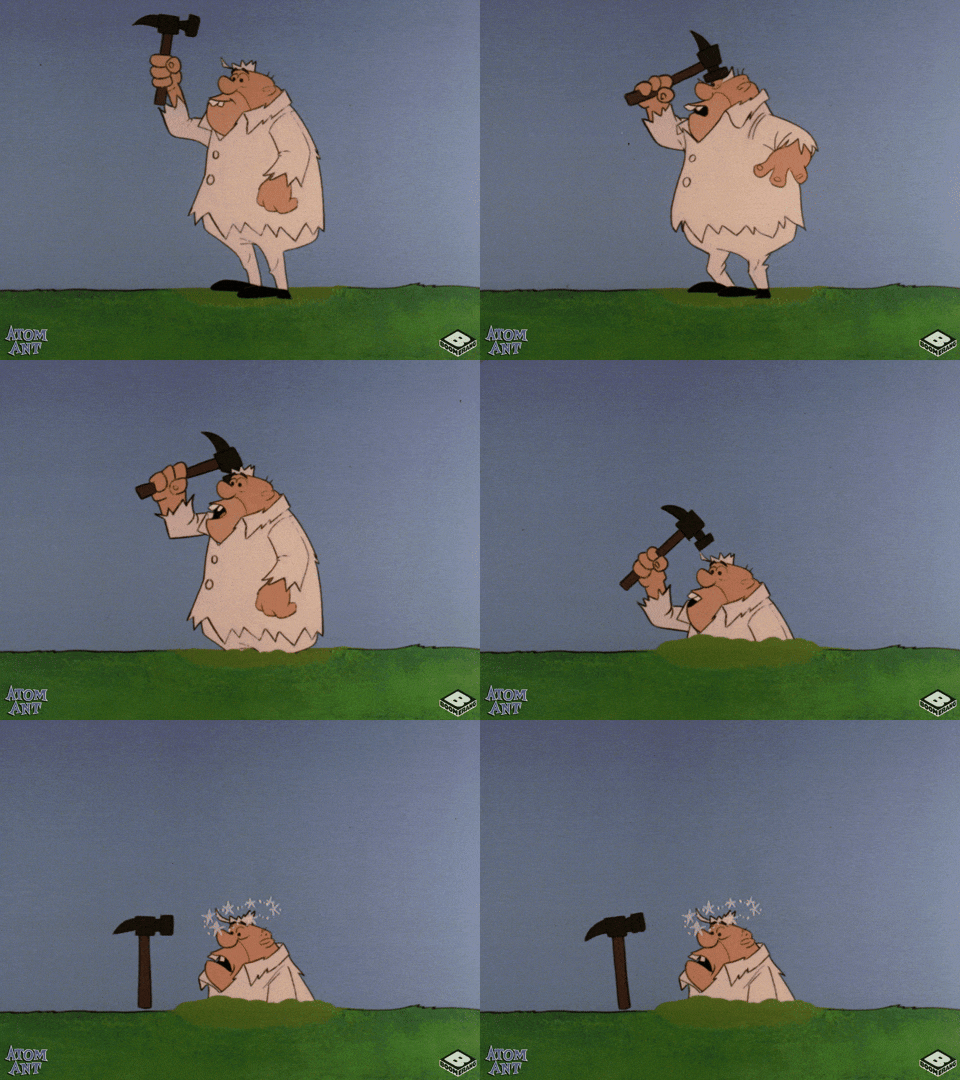
Finishing Nir’s book, apologizing at lunch, and then apologizing to my therapist for answering his question all drove the point home:
Even though I’ve been hard at work getting to know my brain better, I still have some self-limiting beliefs I wasn’t even aware of!
And that’s what we’re going to talk about today: beliefs and how they help and hurt us.
Facts, Faith, and Belief
I’ve known Nir Eyal for about a decade.
When I lived in New York City, I would walk to his apartment and we would co-work at his kitchen table. We’d set a timer, work on our own essays, and then talk about what we were writing. It was some of the most productive, enjoyable work experiences I’ve ever had.
Two years ago, Nir hosted a small group of author friends. While there, he shared that he was writing a book about belief, and I have to admit that I was a bit skeptical…though also intrigued.
I love facts and science. I’m not a particularly religious dude. I am not a fan of “manifesting” or vision boards or toxic positivity. I knew Nir wasn’t a fan of those things either; he loves science and research, and is the author of two very practical books about behavior change.
When I started to read the Beyond Belief, it made sense:
It’s a science-backed book about our brains and the concept of “belief.” Not just “believe in yourself!” but rather, how beliefs shape our reality.
It starts with a clever explanation that separates fact, faith, and belief:
- FACT: An objective truth, verifiable through evidence
- FAITH: A conviction without need for objective evidence
- BELIEF: A firmly held opinion, open to revision based on new evidence
This was an understanding of “belief” my skeptical brain could get behind.
Beliefs are tools: “working models we use to navigate a reality when the truth isn’t fully knowable.” Because our brains are absorbing gazillions of data points every day, it needs some sort of filtering mechanism.
That’s where our beliefs come in: they are the operating system that helps us make decisions all day every day.
Beliefs are a shortcut to help us make sense of a chaotic existence with stimuli coming at us from all angles and senses. So, we have beliefs about our own abilities, politics, food, relationships, our brains, work, children, and so on.
And beliefs can be really really powerful.
The book dives into stories around non-anesthesia surgery, placebo and no-cebo effects, and phantom pain. It also includes one story about monks who can raise their internal body temperature through meditation that feels like it belongs in a comic book.
At the same time, beliefs can be devastating. When they are forced upon us or we unknowingly follow them, they can wreak all sorts of havoc. Our beliefs can limit our potential, cause us to only see the negative in every situation, or miss opportunities that are right in front of us.
After reading this book, then having that therapy session, it made me realize that I still had some self-limiting beliefs that needed to be updated.
5 beliefs I’ve been working hard to update
I have spent a lot of time thinking deeply about how I want to show up in the world.
I’ve done my best to really interrogate the beliefs I’ve adopted and added to my life without realizing it. Beliefs that aren’t true anymore, or that are no longer serving me.
I’ve done this with curiosity, not judgment, because I want to improve how I talk to myself.
So, here are five recent beliefs that I have updated or questioned. I imagine I’ll find many more over the coming years, but this is a good place to start.
BELIEF #1: “I am self-made and independent.” I used to believe that I was proudly independent and earned everything I have. I just worked really hard and made lots of sacrifices and became successful. Everybody else just needed more discipline and motivation and they could also do the same thing!
UPDATED BELIEF: I was born on third base, with no health problems, at the perfect time. I absolutely did work hard, and I created some opportunities for myself, but I also got very lucky. I needed a village of support to get through the last few years. I now know it’s okay to ask for help, and how important it is to recognize not everybody has the opportunities I do.
BELIEF #2: “I need to monitor other people’s emotions.” I like making people happy and can sense when they’re not happy (even if they don’t realize it). This is a gift and a curse. Sometimes this is an unhealthy relationship, where I need to make other people happy in order to be happy. I also care a LOT what other people think of me. It took me probably 38 years to realize that other people’s emotions weren’t my responsibility to manage. Not only that, but it’s okay for me to want to be happy. I know, weird.
UPDATED BELIEF: It’s okay to like making other people happy, but their emotions aren’t my responsibility. I cannot take on the world’s problems and absorb the opinions and emotions of 8 billion people at the same time without going crazy. I can be kind, but I also need to have self-respect and establish healthy boundaries.
BELIEF #3: Once I reach [XYZ milestone] then I will be “enough.” I am a recovering insecure overachiever. I need just a little bit more success and then I can be enough. A bit more money, sell a few more books, get a bit stronger, grow my audience a little bit bigger…and so on and so on and so on.
UPDATED BELIEF: I am enough already. I’m doing what I need to be doing. I’m doing these things to the best of my ability. I’m working on myself and trying to help others. That’s a pretty good place to be.
BELIEF #4: I can be “too much.” I’ve heard this jokingly in the past, but I think I internalized it. It made me believe that I should be quiet more, hide my passions, and avoid “overwhelming” others. It probably kept me from raising my hand, and kept me from sharing my excitement with others.
UPDATED BELIEF: The world needs more passionate, exciting people. That’s me! Also, I think I make people better! I can brighten a room! I can make people feel good! It’s not my responsibility to monitor other people’s emotions, and not everybody needs to like me. My job is to become the best version of me, not contort myself to become some other version of me.
BELIEF #5: I am an entrepreneur who occasionally writes. I started Nerd Fitness as a blog in 2009, and it accidentally became a decent-sized business with employees and a large team helping a huge audience. We created products or services and have a community, and I wrote about specific fitness or health topics that needed a friendly explanation. I wrote to fund the business and pay the salaries and create jobs.
UPDATED BELIEF: I’m a creative artist and writer who accidentally built a fitness business. That business is amazing, but I’m not the person to manage or run it. My interests are so much bigger and broader than just health and fitness. I love making things and dislike managing people. The more time I spend making things and sharing them with the world, the happier I am and the better off the planet is.
Which beliefs don’t work anymore?
As Nir explains in his book, “Beliefs shape what you notice, what you expect, and what you do.” If we believe that we aren’t enough, or that we are unlucky, or that we are doomed, then we will probably notice and take action on things that reinforce these beliefs.
If we are honest with ourselves (a big scary ask), there are probably some beliefs we’ve been living by that are no longer serving us:
Maybe when we were a kid when our mom said “She’s shy,” and although we didn’t think we were shy…suddenly that became part of our identity. And now we identify as a shy person. But maybe we’re not shy? Maybe we thrive in certain environments with our friends. Maybe we can decide that “shy” isn’t serving us, and is holding us back.
Maybe we say to ourselves “I’m not athletic” or “I’m not good at this.” because we struggled as a kid and got frustrated when trying something new. But now, we’ve decided “trying new things is a good use of my time, and I am okay being bad at stuff when starting out.”
Maybe we were raised religious (or agnostic) or part of a political party. And now that we’ve read books and traveled and experienced life, we realize we don’t need to blindly follow the old crowd simply because we were raised a certain way. We get to pick our own values and belief systems.
Interestingly, Nir makes a compelling case for religious ritual in his book, and includes the perspective and lessons from five religions. I’m not religious (though I relate to the practical aspects of Buddhism), but I found this chapter’s argument for ritual to be very compelling!
The good news is that our beliefs are malleable. Once we’re aware of them, we can choose which beliefs get to stay and which ones need interrogation.
It requires tough work. It requires courage to admit “This belief isn’t serving me anymore.” It can be destabilizing and really painful! But damn, it can be liberating too.
Hopefully, we have people in our lives who can point out our limiting beliefs and help us question them. For me, that was therapy last week.
I’d love to hear from you: what’s ONE limiting belief you’re aware of, and how are you choosing to rewrite that belief?
Hit reply on this newsletter and let me know. I read every response (though I have about 500+ replies to get caught up on!).
If “perception is reality,” that means we get to choose the reality that helps us succeed.
I hope you can choose an updated belief today.
-Steve (no longer apologizing for being Steve).
PS: I really enjoyed Beyond Belief.
Nir put years of research into this project, and I found it really thought-provoking. And so perfectly-timed with all the stuff I’m currently working on in therapy.
It’s also got some pretty incredible stories that will have you thinking more about your mindset. I highly recommend giving it a try!